Biography
About Maulana Abul Kalam Azad
Scholar, editor, prisoner, Congress president, minister. A complete account of a life that cannot be told through any one of those words.
Section 01
Who was Maulana Azad?
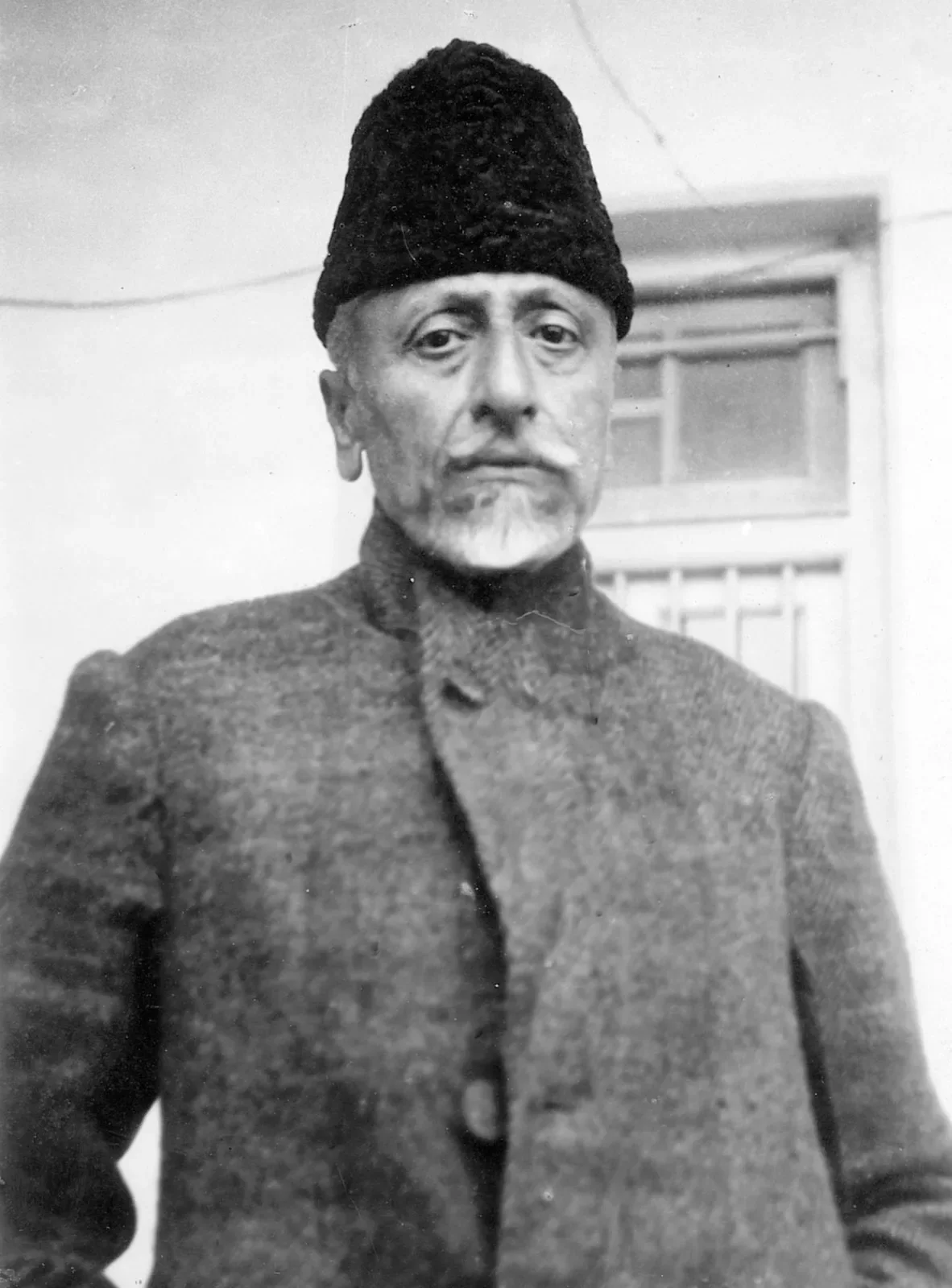
He was born Abul Kalam Ghulam Muhiyuddin in Mecca in 1888, into a family of religious scholars, and died in Delhi in 1958 as the education minister of a republic that had existed for eight years. Almost everything interesting about him happens between those two facts.
Maulana Abul Kalam Azad is remembered in India’s official record as one of the foremost leaders of the freedom struggle, an Islamic scholar of standing, a journalist who was twice silenced by the colonial state, and independent India’s first Minister of Education. Each of those descriptions is accurate. None of them, on its own, explains him.
What connects them is a single conviction, held with unusual consistency across fifty years of public life: that a society is shaped by the quality of its thinking, and that the work of a public person is therefore to argue — carefully, in public, and in a language ordinary readers can follow. He did that as an editor at twenty-four, as Congress president at thirty-five, and as a minister at sixty.
He took the pen-name Azad — “free” — early, and it outlasted every other name he had. It is a reasonable summary of what he wanted for his readers, his community and his country, in roughly that order of difficulty.
- 1888
Born
In Mecca, on 11 November, to Maulana Khairuddin and Sheikha Alia.
- 1912
Al-Hilal
Launched the Urdu weekly that made him a national political voice.
- 1958
Died
In Delhi on 22 February, still holding the education portfolio.
Section 02
A scholar in a changing world
The household Azad grew up in was a serious one. His father was a religious scholar with a substantial following; the family settled in Calcutta around 1890, and the boy was educated at home, in the classical curriculum, by his father and by tutors. Available accounts describe him as an exceptional student who had completed the traditional course of study while still very young.
What makes the story unusual is what he did next. Rather than settling into the role the training implied, he read his way out of it — into history, philosophy, mathematics, the natural sciences, and the political writing of his own century, much of it in languages he taught himself. Government and institutional sources describe him as a scholar educated largely outside any conventional school system, with a range across languages and disciplines that few of his contemporaries matched.
That combination — deep classical training plus wide self-directed modern reading — is the single most important fact about his intellectual life. It gave him standing inside a religious tradition and, at the same time, the vocabulary of modern politics. He spent the next fifty years speaking to both audiences at once, which is a large part of why he was so difficult for anyone to place.
Section 03
From inquiry to public action
Azad’s move from scholarship to politics was not a break; it was a continuation by other means. He was editing journals as a teenager — a poetical journal in 1899, a weekly in 1900, a monthly between 1903 and 1905 — and the habit of addressing a public in print never left him.
By his early twenties he had travelled outside India and had come into contact with political currents in West Asia and Egypt. Historians generally connect that exposure with the sharpening of his anti-colonial position on his return: the conviction that the condition of Indians under British rule was a political problem requiring political organisation, not simply a moral or religious one.
The result was Al-Hilal. It is worth being precise about what was new in it. Urdu journalism already existed. What Azad added was an argument aimed squarely at Muslim readers, telling them that the national movement was theirs, and doing so from within a religious idiom that his readers recognised and trusted.
Section 04
Journalism as political expression
Al-Hilal’s first issue appeared on 13 July 1912. It was produced to an unusually high standard and it found readers quickly. It was also, from the colonial administration’s point of view, a problem: an Urdu weekly with reach, arguing for Indian nationalism and for cooperation across communities, in the years when the First World War was making the government especially sensitive to what Indians were reading.
Government and institutional accounts record that Al-Hilal was suppressed under press legislation in 1914. Azad’s response was to start again: Al-Balagh appeared from 12 November 1915. It ran into 1916, when it too was stopped and Azad was removed from Calcutta under wartime regulations. He was held under restriction — latterly at Ranchi — until 1 January 1920.
Four years of enforced silence is a long time for a writer. It is also, in the logic of colonial rule, a compliment: the state does not detain a journalist it considers harmless.
The full story of both papers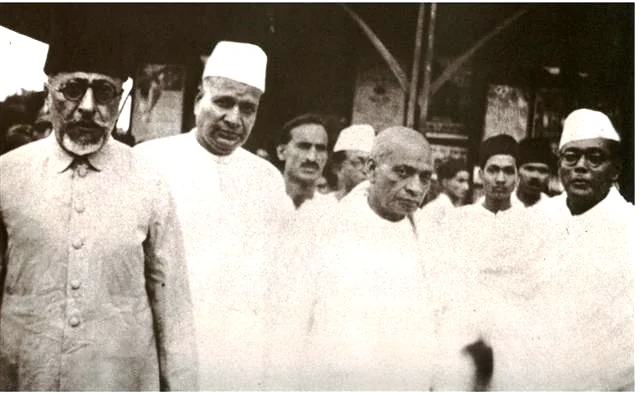
Section 05
A leader of the freedom movement
Released in 1920, Azad entered the mass politics of the Khilafat and Non-Cooperation years and joined the Indian National Congress. He remained inside it for the rest of his life. In 1923, at thirty-five, he presided over the Congress’s special session in Delhi — the youngest person to hold that office.
The following two decades follow a rhythm familiar from many Indian political biographies of the period: organisation, agitation, arrest, release, repeat. He was imprisoned during the civil disobedience years of the 1930s. He was elected Congress president again at the Ramgarh session in 1940 and held the office through the Second World War until 1946 — the longest and most consequential stretch of his political career.
When the Quit India resolution was passed in Bombay in August 1942, Azad was the sitting president of the Congress. He was arrested with the rest of the leadership within days, and held at Ahmednagar Fort. The years there produced Ghubar-e-Khatir, a book of letters that is now considered among the finest Urdu prose of the century.
Section 06
The vision of a shared India
Azad’s central political argument was that India was one nation, not two, and that Indian Muslims were part of that nation rather than a separate people negotiating with it. He made the case at length in his 1940 presidential address at Ramgarh, and he kept making it through the negotiations of 1946 and 1947.
“I am proud of being an Indian. I am a part of the indivisible unity that is Indian nationality.” Presidential address, Indian National Congress, Ramgarh session, 1940 — widely reproduced English translation
In the same address he described the thousand years of shared life in India as having “moulded us into a common nationality”. This was a historical claim as much as a political one, and it was the ground on which he opposed the demand for a separate state.
He lost that argument. Partition happened, in August 1947, with consequences whose scale is still being counted. What is worth recording is that he did not treat the loss as a reason to withdraw. On 23 October 1947, from the steps of the Jama Masjid in Delhi, he addressed Muslims who had stayed in India and urged them not to leave and not to live as supplicants. Accounts of the speech record him telling his listeners that if they did not wish to flee, nobody could make them flee.
Partition & the idea of IndiaSection 07
Education and nation building
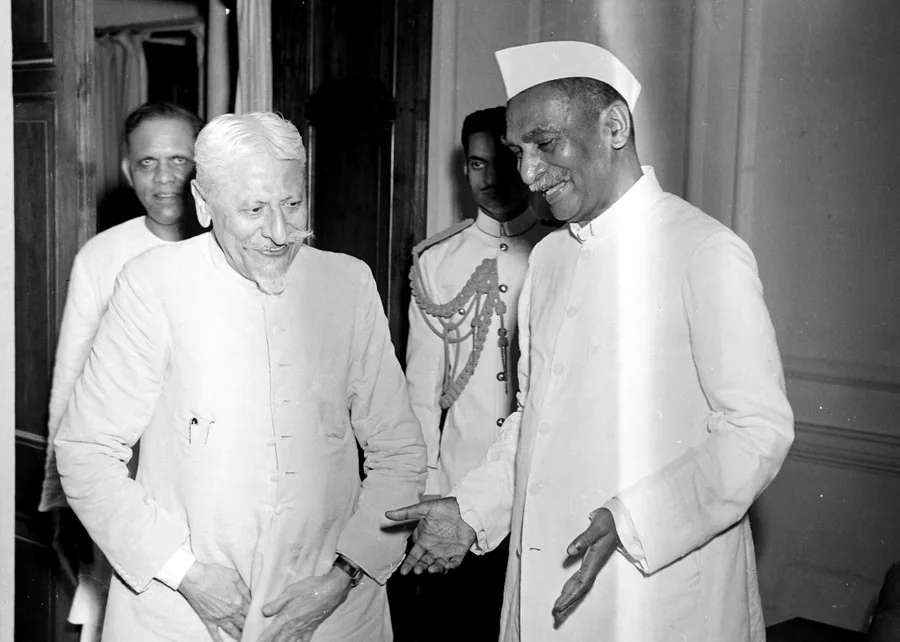
On 15 August 1947 Azad became independent India’s first Minister of Education. He held the portfolio — later expanded to include natural resources and scientific research — until his death eleven years later. No Indian education minister has served longer.
Government sources record the priorities he pressed throughout: free and compulsory education for children, the education of girls and women, the teaching of modern science, the expansion of technical education, and the quality of university teaching. He also served in the Constituent Assembly from 1946, and was elected to the Lok Sabha from Rampur in 1952.
The institutional record of those eleven years is substantial: the first Indian Institute of Technology at Kharagpur in 1951, the Indian Council for Cultural Relations founded in 1950 with Azad as its first president, the three national academies for letters, the performing arts and the visual arts established between 1952 and 1954, and the University Grants Commission, which he inaugurated on 28 December 1953. These were collective achievements of a young state; his part in them is documented and specific.
Section 08
Why his legacy matters
Azad died in Delhi on 22 February 1958. He was awarded the Bharat Ratna, India’s highest civilian honour, posthumously in 1992. Since 2008 his birth anniversary, 11 November, has been observed across the country as National Education Day.
The reason his legacy has proved durable is not sentiment. It is that the questions he worked on have not been settled. How does a diverse society hold together without insisting on uniformity? What does a state owe a child who cannot pay for schooling? How much science should a general education contain? What is a country’s culture for, when it meets the rest of the world?
He answered those questions in a specific historical situation, with the resources of a newly independent and very poor state. Some of his answers were superseded; some are still policy. But the framing survives, and it is unusually clear: education is not a service the state provides to individuals. It is the mechanism by which a democracy reproduces its own capacity to function.
That is why the date matters. National Education Day is not a commemoration of a man. It is an annual reminder of an argument he insisted on making.